
Learning how to start freelancing with no experience might feel like trying to enter a locked room without a key. The truth? You already have everything you need to begin your freelancing journey—you just need to know where to look and how to position yourself. In 2026, the freelance economy has exploded past $1.5 trillion globally, with 73.3 million Americans freelancing. This isn’t a side hustle anymore; it’s a legitimate career path that rewards initiative over credentials.
This comprehensive guide will show you exactly how to start freelancing with no experience—even if you’re starting from absolute zero. Whether you’re a college student, career switcher, or stay-at-home parent looking for flexibility, the freelance world is more accessible than ever. But here’s what separates those who make it from those who quit after three weeks: understanding that freelancing is a business, not just ‘working from home in pajamas.’
By the end of this article, you’ll have a clear roadmap to land your first client, build credibility from scratch, and avoid the costly mistakes that trip up 90% of beginners. Let’s get started.
What Does It Mean to Be a Freelancer?

A freelancer is a self-employed professional who offers services to clients on a project or contract basis rather than working as a traditional employee. If you’re researching how to start freelancing with no experience, think of freelancing as being the CEO, sales team, and entire workforce of your own micro-company—all rolled into one person.
Here’s what freelancing actually looks like in practice:
-
You choose your clients and projects based on your interests, schedule, and income goals—no one assigns you work.
-
You set your own rates and negotiate directly with clients, which means your earning potential isn’t capped by a salary band.
-
You handle everything from marketing and sales to project delivery and invoicing—there’s no HR department or accounting team.
-
You work remotely or on your own terms, which offers unprecedented flexibility but requires strong self-discipline.
The biggest misconception? That freelancing is just “doing gigs.” Real freelancing is about building sustainable client relationships. A graphic designer doesn’t just create one logo—they become the go-to designer for a company’s ongoing branding needs. A writer doesn’t just submit one article—they establish themselves as the trusted voice for a publication’s niche.
This distinction matters because when you’re figuring out how to start freelancing with no experience, you’re not just learning a skill—you’re learning how to run a business where you are the product.
Can I Freelance With No Experience?
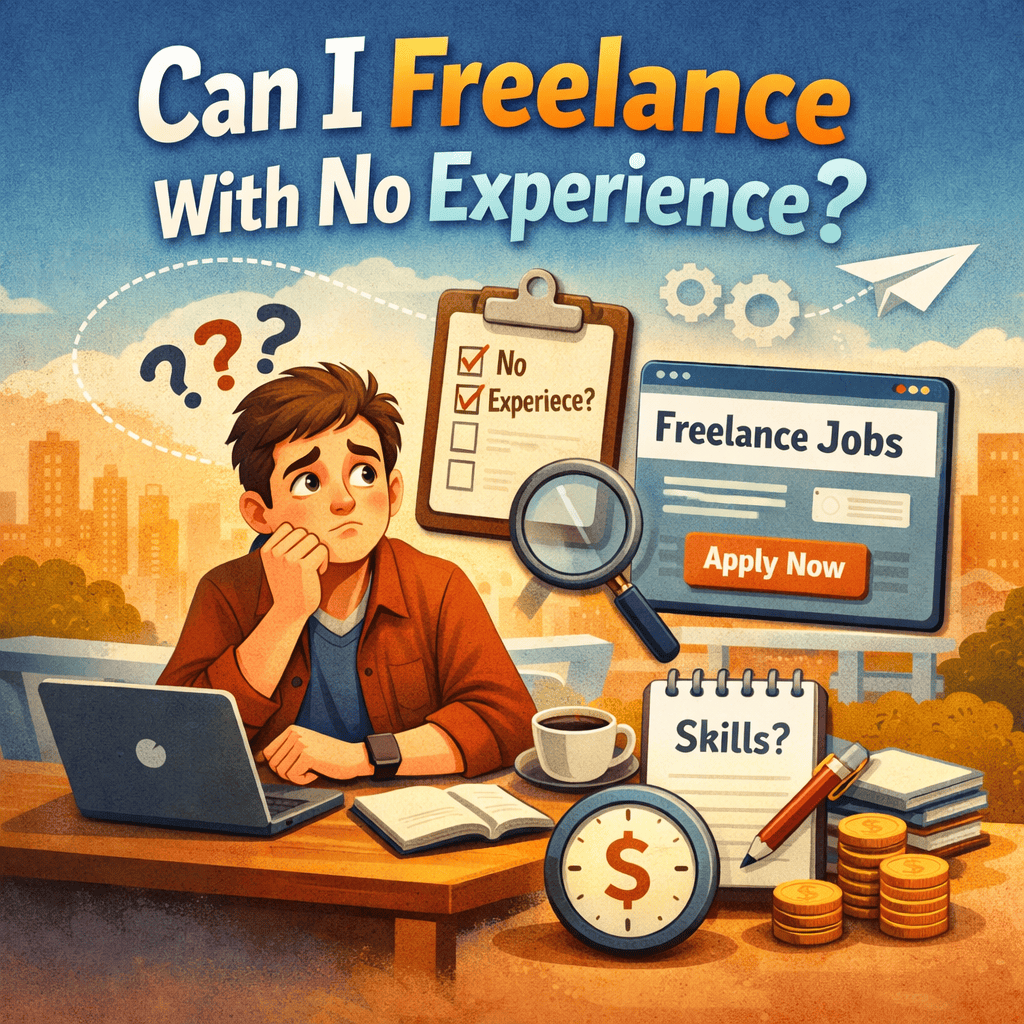
Yes—and here’s the counterintuitive truth: your lack of traditional experience can actually be an advantage if you position it correctly. When you start freelancing with no experience, you bring something just as valuable in 2026’s market: fresh perspective, hunger to prove yourself, and willingness to adapt quickly.
Here’s why no experience doesn’t disqualify you:
1. Skills Matter More Than Credentials
Clients don’t care about your resume—they care about results. A business owner looking for social media management doesn’t need to see your degree in communications; they need to see that you understand their audience and can create engaging content. Most freelancing skills can be learned in weeks through focused online courses, YouTube tutorials, and deliberate practice.
2. Portfolio Projects Count as Real Experience
Create work samples before you get paid. If you want to be a web designer, redesign a local business’s terrible website as a spec project. If you want to write blog content, publish 5-10 articles on Medium demonstrating your expertise. These samples prove you can do the work—no one needs to know you haven’t been paid yet.
3. Micro-Projects Build Credibility Fast
Platforms like Fiverr and Upwork let you start with small jobs that require minimal experience. Complete 10-15 micro-projects, earn five-star reviews, and suddenly you have documented proof of reliability and skill. Your first clients might pay $25 for a simple task, but those reviews are worth thousands in future credibility.
4. Specialized Niches Reduce Competition
Don’t try to compete with experienced generalists. Instead, become the go-to person for a specific niche. Rather than ‘social media manager,’ position yourself as ‘Instagram growth specialist for sustainable fashion brands.’ Niching down lets you charge premium rates with less experience because you’re solving a specific problem for a specific audience.
The key freelancing tip here: reframe your inexperience as specialization. You’re not ‘new to freelancing’—you’re ‘focusing exclusively on helping early-stage startups with content strategy’ or ‘specializing in modern, minimalist web design for wellness brands.’ See the difference?
How To Start Freelancing With No Experience
Now for the practical execution. This isn’t theory—this is the exact step-by-step process thousands of successful freelancers have used to go from zero to paid clients in under 30 days.
Step 1: Identify Your Marketable Skill (Even If You Don’t Think You Have One)
Every successful freelancer started by matching what they can learn quickly with what the market actually needs. Audit yourself honestly:
- What do people already ask you for help with? Maybe friends constantly ask you to design their Instagram posts, edit their photos, or explain tech concepts. That’s a signal.
- What could you learn in 2-4 weeks that businesses desperately need? Email marketing, basic video editing, SEO writing, Canva design templates, data entry automation, virtual assistance—these are all learnable fast.
- What do you already know from hobbies or past jobs? An ex-retail worker understands customer service (perfect for community management). A parent who organizes family schedules can become a project coordinator. A fitness enthusiast can create workout content.
Pick ONE skill to start. The biggest mistake beginners make is offering ‘writing, design, social media, and web development.’ You’re not building an agency yet—you’re establishing expertise. Choose the skill where you can deliver results fastest and enjoy the work enough to practice it daily.
Step 2: Get Training (The Free Way)
You don’t need expensive courses. In 2026, world-class training is free:
- YouTube: Search ‘[your skill] tutorial for beginners’ and watch the top 10 videos. Then search ‘advanced [your skill] techniques’ and watch those. Free and comprehensive.
- Free platforms: Google Digital Garage (marketing), freeCodeCamp (web development), Coursera audit mode (hundreds of courses), HubSpot Academy (sales and marketing certifications).
- Study successful freelancers: Find 5 people doing what you want to do. Analyze their portfolios, pricing, service descriptions, and client testimonials. Reverse-engineer their success.
Dedicate 2-3 hours daily for two weeks. That’s 30-40 hours of focused learning—equivalent to a week-long intensive bootcamp. The goal isn’t mastery; it’s competence. You need to be good enough to solve real problems for paying clients.
Step 3: Build Your Portfolio With Fictional or Pro Bono Projects
This is where most beginners stall—but it’s actually the easiest step if you’re willing to create work before getting paid:
Option 1: Redesign/reimagine existing work
Pick 3-5 businesses in your niche and create improved versions of their work. If you’re a writer, rewrite their bland About page with compelling copy. If you’re a designer, redesign their logo or social media posts. If you’re a web developer, rebuild their homepage with modern design. Present these as ‘portfolio projects’ or ‘case studies.’
Option 2: Do pro bono work for nonprofits or small businesses
Reach out to 10 local nonprofits, churches, or struggling small businesses. Offer your service free in exchange for a testimonial and portfolio piece. Be explicit: ‘I’m building my portfolio and would love to help with [specific project]. In exchange, I’d need a testimonial and the ability to showcase the work.’ Most say yes.
Option 3: Create your own fictional brand
Invent a fake company and create comprehensive work for it. Build a complete brand identity, write a content series, design a full website mockup. Be transparent it’s not a real client, but the work itself demonstrates your skills. Many successful freelancers have ‘concept projects’ in their portfolios.
Your portfolio needs 3-5 strong pieces. Quality over quantity. Each piece should show your process (before/after, strategy explanation, results achieved) not just the final product.
Step 4: Set Up Your Basic Online Presence
You need to be findable and credible. Minimum viable presence:
- LinkedIn profile: Optimize your headline (not ‘Aspiring Writer’ but ‘Content Writer | SaaS Companies & Tech Startups’). Add your portfolio pieces to the Featured section. Write a summary that focuses on client benefits, not your story.
- Simple portfolio site: Use Notion (free), Carrd ($19/year), or WordPress. Three pages: About (who you help), Portfolio (your best 3-5 projects), Contact. That’s it.
- Professional email: yourname@gmail.com is fine to start. Later upgrade to yourname@yourdomain.com for $12/year through Google Workspace.
Don’t overthink this. Your online presence should take one weekend maximum to set up. You’ll refine it as you get real clients and testimonials.
Step 5: Start Pitching (The Right Way)
Most freelancers fail here because they send generic pitches or wait for clients to find them. Here’s what actually works:
The 10-10-10 Method:
- 10 warm pitches: Reach out to people you know—friends, former colleagues, family connections. Message: ‘I’m launching a freelance [service] business. Do you know anyone who needs [specific outcome]? Happy to offer a friends-and-family rate for referrals.’
- 10 platform applications: Apply to 10 jobs on Upwork, Fiverr, or Freelancer that match your skill level. Start with smaller projects ($50-$200 range) where competition is lower. Customize each proposal—reference something specific from their job posting.
- 10 cold outreach messages: Find businesses that need your service (check their websites, social media). Send personalized messages pointing out a specific problem and how you’d solve it. Don’t ask for a job—offer a free audit, quick win, or consultation.
Do this daily. 30 quality pitches per day = 210 per week. If your pitch is relevant and valuable, you’ll get a 5-10% response rate. That’s 10-20 conversations per week, leading to 2-4 trial projects per month. After your first 5 projects, you’ll have testimonials and can raise rates.
What makes a good pitch:
- Lead with their problem, not your credentials: ‘Noticed your Instagram engagement dropped 40% last quarter’ beats ‘I’m a social media manager with 6 months experience.’
- Offer something specific and valuable: ‘I’ll analyze your top 10 competitors’ content strategy and send you a 2-page report—free, no strings. If it’s valuable, we can discuss working together.’
- Make it easy to say yes: Include your portfolio, a clear next step, and a low-commitment offer. ‘Want to start with one article to test the fit?’
Your first client often comes from warm connections, not cold platforms. Don’t neglect your network just because you’re new to freelancing.
Step 6: Deliver Exceptional Work & Build Your Reputation
Your first few clients are your reputation foundation. Overdeliver ruthlessly:
- Underpromise, overdeliver: If they need 5 social media posts, deliver 7. If the deadline is Friday, deliver Wednesday.
- Communicate proactively: Send progress updates before they ask. Flag potential issues early. Be responsive within 24 hours maximum.
- Ask for testimonials immediately: Right after delivery, when they’re happiest, ask: ‘Would you be willing to write a brief testimonial about your experience? Specific results are most helpful—like how the work impacted your business.’
- Request referrals: ‘I’m growing my client base. Do you know anyone else who might benefit from [your service]? Happy to offer them the same rate/quality as you received.’
One delighted client can refer you to five others. One average experience gets forgotten. Make your early work unforgettable—not through perfection, but through care, reliability, and exceeding expectations.
Some Freelancing Roles That Can Get You A Good Start
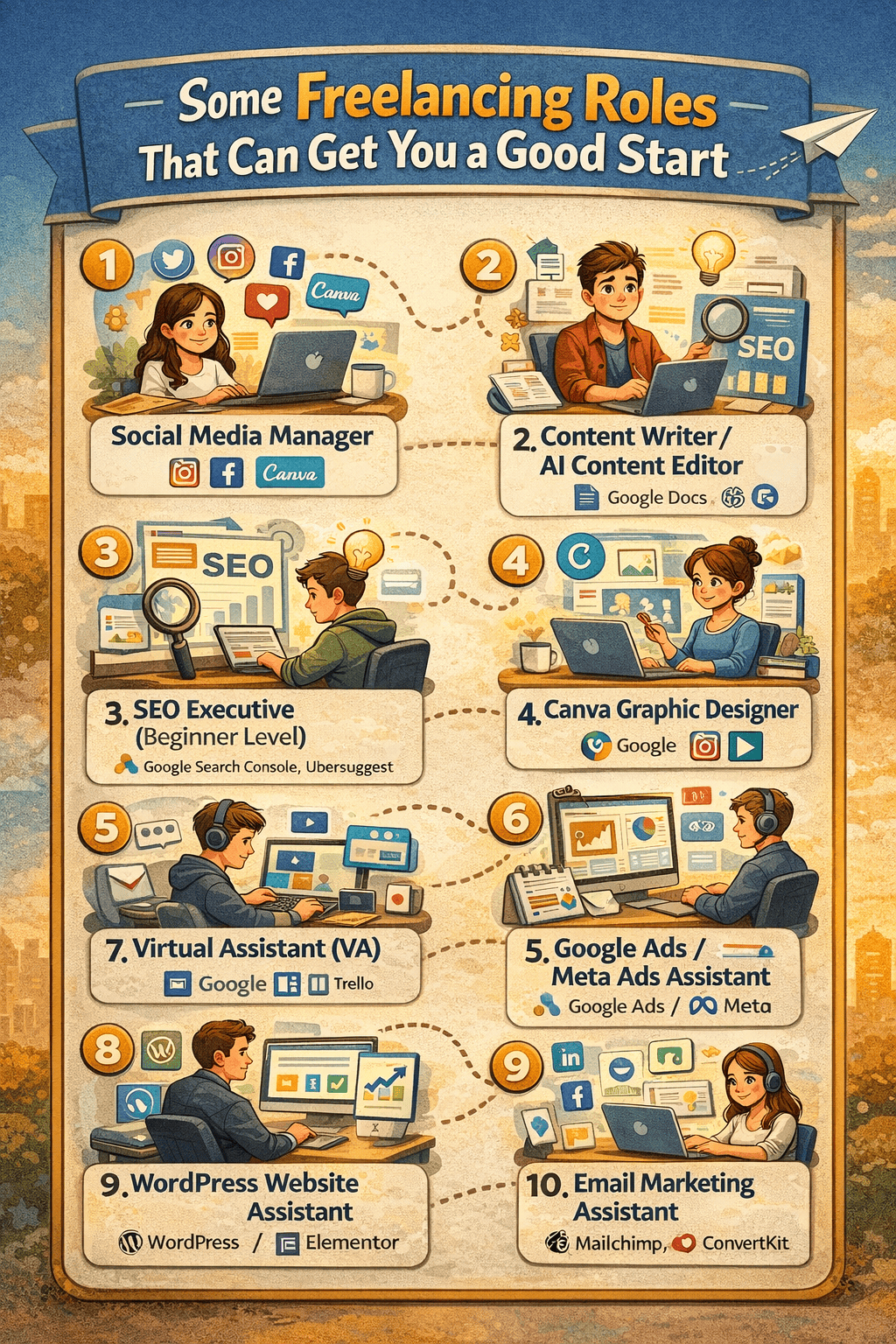
Not all freelance roles are created equal for beginners looking to start freelancing with no experience. Some have lower barriers to entry, faster learning curves, and more consistent demand. Here are the roles where you can realistically land paid work within 30 days—even with no prior experience.
1. Content Writer / Copywriter
Why it works for beginners:
If you can write clearly and research thoroughly, you can get paid to create blog posts, website copy, email newsletters, and product descriptions. The barrier to entry is low—no certifications required, just demonstrated writing ability.
How to start:
- Write 5-10 sample articles in a niche you understand (fitness, personal finance, parenting, tech, etc.)
- Publish them on Medium or LinkedIn to demonstrate your voice and expertise
- Apply to content agencies or bid on beginner-level writing gigs (typical starting rate: $0.03-0.08 per word)
Reality check: You’ll start at low rates, but after 20-30 articles, you can double your rates and pitch directly to businesses.
2. Social Media Manager
Why it works for beginners:
Small businesses desperately need consistent social media presence but can’t afford full-time staff. If you understand Instagram, TikTok, LinkedIn, or Facebook better than a 45-year-old business owner (which you probably do), you can get hired.
How to start:
- Choose one platform to specialize in initially (Instagram for visual brands, LinkedIn for B2B, TikTok for Gen Z products)
- Create a portfolio account showcasing content for a fictional brand in your niche
- Offer to manage social media for one small business for 30 days at a steep discount in exchange for a testimonial
Reality check: Start with one client, prove you can increase engagement and followers, then package that case study to land 3-5 clients at $500-1500/month each.
3. Virtual Assistant (VA)
Why it works for beginners:
Virtual assistance is incredibly broad—email management, calendar scheduling, data entry, customer service, travel booking, research. If you’re organized and competent with basic tools, you can start immediately.
How to start:
- Get familiar with common VA tools: Google Workspace, Calendly, Trello, Slack, Zoom
- List specific tasks you can handle (not just ‘general VA services’): inbox management, podcast show notes, CRM data entry, etc.
- Target busy solopreneurs, coaches, and consultants who need administrative support but not a full-time hire
Reality check: VAs typically start at $15-25/hour. Once you prove reliability, you can specialize (Executive VA, E-commerce VA, Real Estate VA) and charge $40-75/hour.
4. Graphic Designer (Using Templates)
Why it works for beginners:
You don’t need Adobe expertise anymore. Canva has democratized design—you can create professional-looking social media graphics, presentations, infographics, and marketing materials using templates and customization.
How to start:
- Master Canva Pro ($13/month—worth it for unlimited resources)
- Study design principles: color theory, typography basics, visual hierarchy (free courses on YouTube)
- Create a mock brand kit and design suite (logo, social media templates, presentation deck) as portfolio pieces
Reality check: Start by offering social media design packages ($150-300 for 15-30 branded templates). Scale into full brand identity design as skills improve.
5. Video Editor (Short-Form Content)
Why it works for beginners:
The explosion of TikTok, Instagram Reels, and YouTube Shorts has created massive demand for quick video editors. Content creators film raw footage but need editors to add captions, transitions, music, and effects.
How to start:
- Learn CapCut (free mobile/desktop app) or DaVinci Resolve (free professional software)
- Practice by re-editing popular videos in your niche—add your own flair to existing content
- Reach out to content creators with 10-50K followers (they’re making money but can’t afford expensive editors yet)
Reality check: Charge per video initially ($15-40 for short-form, depending on complexity). Once you build efficiency, offer monthly packages (30 edited videos for $500-900).
6. Data Entry Specialist
Why it works for beginners:
Unglamorous but consistently available. Businesses need information transferred into spreadsheets, CRMs updated, databases cleaned, and documents digitized. If you’re detail-oriented and can type accurately, you can start today.
How to start:
- Get comfortable with Google Sheets, Microsoft Excel, and basic database tools
- Apply to beginner-friendly platforms like Clickworker, Microworkers, and Amazon Mechanical Turk to build reviews
- Emphasize speed and accuracy in pitches—offer to do a free sample (30 minutes of work) to prove competence
Reality check: Pay is modest ($10-20/hour initially), but you can quickly move into specialized data work (market research, lead generation, CRM management) at $25-50/hour.
Tools That Can Help You In Freelancing!
The right tools can make you look professional, work faster, and deliver higher-quality results. Here’s the essential freelancer toolkit—prioritized by what you actually need when starting out.
Project & Time Management
- Notion (Free): All-in-one workspace for notes, project tracking, client databases, and content calendars. Replaces five other tools.
- Trello (Free): Visual project management with boards and cards. Perfect for managing multiple client projects simultaneously.
- Toggl Track (Free): Time tracking to understand how long tasks actually take and bill accurately for hourly work.
- Google Calendar (Free): Schedule client calls, set project deadlines, and block time for deep work. Integrate with scheduling tools.
Communication & Meetings
- Zoom (Free tier): Video calls with clients. The free version allows 40-minute meetings—plenty for most client check-ins.
- Calendly (Free): Let clients book meetings without the email back-and-forth. Syncs with your Google Calendar automatically.
- Slack (Free): Professional communication that keeps conversations organized by project. Better than endless email threads.
- Loom (Free): Record quick video explanations instead of writing long emails. Perfect for feedback, tutorials, or project updates.
Design & Creative Work
- Canva Pro ($13/month): Essential for graphic design, social media content, presentations, and marketing materials. The ROI is immediate.
- Figma (Free): Professional design tool for websites, apps, and user interfaces. Industry-standard and completely free to start.
- Remove.bg (Free tier): Instantly remove backgrounds from images—saves hours of manual editing.
Content Creation & Writing
- Grammarly (Free): Catches grammar mistakes and improves clarity. The free version is sufficient for most freelance writing.
- Hemingway Editor (Free): Makes your writing clearer and more concise by highlighting complex sentences and passive voice.
- Google Docs (Free): Collaboration features make it perfect for sharing drafts with clients and tracking revisions.
Invoicing & Payments
- Wave (Free): Completely free invoicing, accounting, and receipt scanning. Perfect for beginners who aren’t ready for paid tools.
- PayPal / Stripe (2.9% + $0.30 per transaction): Accept credit card payments professionally. Integrate with invoicing tools.
- Wise (formerly TransferWise): Best for international payments—much lower fees than PayPal for cross-border transactions.
Start with the free tools. As you earn money, reinvest 10-15% into paid tools that save time or improve quality. Your first $1,000 in freelance income should unlock Canva Pro, a domain + email, and maybe one specialized tool for your niche.
Websites Where You Can Find Freelancing Work!
Finding clients is the hardest part of freelancing—these platforms solve that problem by connecting you with people actively looking to hire. Each platform has different strengths, fee structures, and ideal use cases.
Upwork (Best for: Intermediate to Advanced Freelancers)
The largest freelance marketplace with millions of jobs posted annually. Covers every category imaginable—writing, design, development, marketing, admin support.
How it works:
- Browse job postings and submit proposals (you get limited free ‘Connects’ per month, then pay for additional proposals)
- Upwork takes a sliding fee: 20% on your first $500 with a client, 10% from $500-$10,000, then 5% after $10,000
- Payment protection ensures you get paid—funds are held in escrow for hourly work tracked through their software
Beginner strategy:
Start with smaller jobs ($100-300) to build reviews and Job Success Score. Write customized proposals referencing specific details from the job posting. Initially bid competitively to get your first 5-10 reviews, then raise rates. Focus on clients with payment verification and good hiring history.
Fiverr (Best for: Complete Beginners)
Unlike Upwork where you apply to jobs, Fiverr is a marketplace where you create ‘Gigs’ (service listings) and clients come to you. Perfect for beginners because you control pricing and service description.
How it works:
- Create gigs offering specific services (e.g., ‘I will write a 500-word SEO blog post for $30’)
- Fiverr takes 20% commission on all orders
- You can offer three pricing tiers (Basic, Standard, Premium) to upsell clients
Beginner strategy:
Price competitively initially to get your first 10-20 five-star reviews. Use keyword-rich titles and descriptions for SEO within Fiverr. Create multiple gigs targeting different aspects of your service. Deliver fast and overdeliver slightly—reviews determine your ranking in search results. You will also find a lot of Jobs around SEO Keyword Research, so you can quikcly learn and try to get on those jobs.
LinkedIn (Best for: Building Long-Term Client Relationships)
Not a traditional freelance marketplace, but one of the most effective platforms for finding clients through networking and visibility.
How it works:
- Optimize your profile with a professional headline, detailed experience, and portfolio samples in the Featured section
- Share valuable content in your niche to demonstrate expertise and attract inbound inquiries
- Use ‘Open to Work’ feature and browse job postings (many companies post freelance positions)
- Direct outreach to potential clients with personalized connection requests and messages
Beginner strategy:
Connect with 20-30 people per week in your target industry. Publish 3-5 posts per week sharing insights, tips, or case studies in your niche. Engage genuinely with others’ content. When reaching out, lead with value—offer a free audit, helpful resource, or specific observation about their business.
Freelancer.com, Contra, PeoplePerHour
Additional platforms worth exploring once you’ve established yourself on Upwork or Fiverr. Each has its own community and fee structure. Freelancer.com is good for budget projects, Contra is commission-free for creative professionals, and PeoplePerHour is strong in the UK/European market.
Platform recommendation by stage: Weeks 1-4 (building reviews): Fiverr + Upwork small jobs. Months 2-6 (establishing expertise): Upwork medium projects + LinkedIn networking. Month 6+ (premium clients): LinkedIn outreach + direct client acquisition. Use platforms to get started, but always work toward building a client base that comes directly to you.
Common Obstacles and Fixes!
Freelancing looks simple from the outside—do work, get paid. But every freelancer faces predictable challenges that can derail progress if not handled correctly. Here’s how to navigate the most common obstacles.
Obstacle 1: “I’m Not Getting Any Responses to My Proposals”
This is the #1 complaint from new freelancers. You’re applying to jobs, but hearing crickets. The problem isn’t you—it’s your approach.
Why it happens:
- Generic proposals that could apply to any job
- Focusing on what you want instead of what the client needs
- Competing on oversaturated high-budget projects
- Incomplete profile with no portfolio or reviews
The fix:
- Customize every proposal: Reference specific details from their job posting. Show you actually read it.
- Lead with value: Start with their problem and your specific solution, not with ‘Hi, I’m a freelance writer with 3 years experience…’
- Target smaller projects: Jobs with $100-300 budgets and 5-15 proposals have better response rates than $1000+ jobs with 50+ proposals.
- Include samples: Attach 1-2 relevant portfolio pieces directly in your proposal.
Reality check: Even experienced freelancers get 90% rejection. It’s a numbers and quality game. Send 10 thoughtful proposals daily rather than 50 templated ones.
Obstacle 2: “How Do I Price My Services When I Have No Experience?”
Pricing is paralyzing for beginners. Too high and you won’t get hired; too low and you’ll work yourself to exhaustion for pennies.
The fix:
Use the 3-tier strategy:
- Portfolio-building rate (first 5-10 clients): Price 30-50% below market to compensate for lack of reviews/testimonials.
- Competitive rate (clients 11-30): Match the lower-middle of market rates as you now have proof of competence.
- Premium rate (client 31+): With testimonials and case studies, price at or above market rate based on your specialization and results.
Practical rule: Calculate your minimum viable rate by determining how much you need to earn monthly, dividing by billable hours (typically 50-60% of total work hours), and adding 30% buffer for taxes/expenses. Never go below this number.
Obstacle 3: “Client Won’t Pay Me / Payment Issues”
Nothing is more demoralizing than completing work and not getting paid. This happens to almost every freelancer at least once.
The fix:
- Use platform escrow: For first 3-5 projects with any client, work through Upwork/Fiverr/etc. where payment is guaranteed.
- Always use contracts: Even simple agreements outlining deliverables, deadlines, payment terms, and revision policies.
- Require 50% deposit: For projects over $500, get half upfront. This filters out non-serious clients and protects your time.
- Use milestone payments: Break large projects into phases with payment after each phase approval.
If a client hasn’t paid: Send a friendly reminder after 3 days past due. Follow up again at 7 days with firmer language. At 14 days, send a final notice mentioning you’ll pause work and may pursue collections. Document everything.
Obstacle 4: “I’m Overwhelmed and Don’t Know Where to Start”
The fix:
Follow the 30-day action plan:
- Week 1: Pick ONE skill and complete a crash course (10-15 hours total). Create 2-3 portfolio pieces.
- Week 2: Set up basic online presence (LinkedIn profile, simple portfolio site). Write one service description.
- Week 3: Send 10 warm pitches + 20 platform proposals. Focus on getting first client, not perfect client.
- Week 4: Complete first project. Get testimonial. Apply learnings to improve process for next client.
The key: 80% execution, 20% learning. You’ll learn more from one real project than from 10 hours of tutorials. Start messy, refine later.
Obstacle 5: “Income is Inconsistent and Unpredictable”
The fix:
- Build retainer clients: Pitch ongoing monthly packages to existing clients.
- Follow the 60/40 rule: 60% of time on client work, 40% on marketing and business development. Never stop marketing.
- Maintain a savings buffer: Save 3-6 months of expenses specifically for lean periods.
- Diversify income streams: Combine project work, retainers, and passive income (templates, courses, affiliate commissions).
Income stability comes from systems, not luck. Build predictable processes for finding and nurturing clients—not just delivering great work.
Conclusion
Learning how to start freelancing with no experience isn’t just possible—it’s how the majority of successful freelancers began. The difference between those who make it and those who give up after a month isn’t talent, credentials, or luck. It’s execution.
You now have the complete roadmap. You know which skills are most accessible for beginners. You understand how to build a portfolio from nothing. You’ve learned how to pitch clients, price your work, and use platforms to find opportunities. You’re equipped with the tools, websites, and strategies that working freelancers use every day. And you know how to overcome the obstacles that derail most beginners before they get started.
What separates this guide from generic advice you’ll find elsewhere? Everything here is actionable. There’s no vague ‘be passionate’ or ‘believe in yourself.’ Instead, you have specific actions: spend 2-4 weeks learning a skill, create 3-5 portfolio pieces, send 30 pitches per day using the 10-10-10 method, start with Fiverr to build reviews, use Wave for invoicing, and follow the 60/40 rule for sustainable income.
The brutal truth about freelancing: your first three months will be harder than expected. You’ll send proposals that get ignored. You’ll undercharge. You’ll work with difficult clients. You’ll question whether you made the right choice. This is normal. Every successful freelancer experienced it. The ones who succeed simply refused to quit during this phase.
Your 30-day action plan starts now:
- Today: Choose your service and start learning (dedicate 2-3 hours minimum)
- Days 1-14: Complete skills training and create 3-5 portfolio pieces
- Days 15-21: Set up online presence (LinkedIn, portfolio site, platform profiles)
- Days 22-30: Send 30 pitches daily. Your goal: land first paid client.
By day 30, you should have at least one client, several active conversations, and momentum. By month three, you should have 5-10 completed projects and $1,000-3,000 in earnings. By month six, you’re building toward consistent monthly income that could replace your day job or become your primary income.
The freelance economy is expected to grow to $12 trillion globally by 2030. Companies increasingly prefer flexible talent over full-time hires. Remote work has normalized hiring people regardless of location. The barriers to entry have never been lower, and the opportunities have never been greater.
But opportunity without action is just information. Close this guide, pick one thing to do in the next hour, and do it. Not tomorrow. Not next week when you have more time. Right now. Whether that’s signing up for a free course, creating your first portfolio piece, or writing your first pitch—take one concrete action while you’re motivated.
Remember: every expert freelancer earning six figures started exactly where you are now—with no clients, no reviews, and no idea if they’d succeed. The only difference is they started. They sent that first awkward pitch. They delivered that first imperfect project. They pushed through the uncertainty.
Your freelance journey doesn’t begin when you feel ready. It begins when you decide you’re ready enough and take the first step anyway. If you’ve been wondering how to start freelancing with no experience, you now have everything you need to take that first step today.
Welcome to freelancing. Your first client is waiting.